Regular assessments allow building owners to pinpoint necessary repairs. By addressing these issues promptly, the potential for fire and smoke to spread through a building is significantly reduced, granting occupants extra time needed to evacuate safely (or stay put if that is the building's strategy). A robust maintenance strategy should ideally blend frequent internal visual checks with technical surveys performed by competent or qualified professionals.
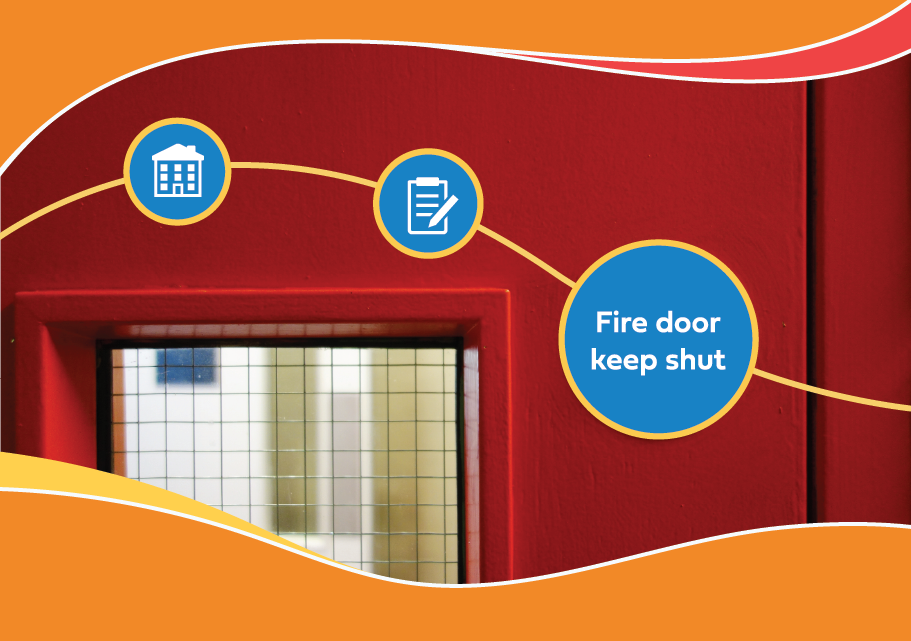
Fire doors serve as a cornerstone of fire protection. Found in nearly every type of structure, these specialised installations are designed to shield escape routes and isolate high-risk zones. They are functional items used daily, meaning they are frequently prone to deterioration from constant use, accidental impact, or general wear. To maintain their life-saving capabilities, it is essential that these doors undergo checks to confirm they remain fit for purpose.

What is a fire door?
The primary function of a fire door is to act as a barrier against the passage of flames and toxic gases. These work in tandem with the building’s overall compartmentation, which is the practice of dividing a structure into “cells” to contain a fire at its point of origin.
What’s the law?
Beyond safety best practices, maintaining these barriers is a statutory necessity. In England and Wales, compliance is mandated by the Building Regulations and the Regulatory Reform (Fire Safety) Order 2005. Equivalent legislation is active in Scotland and Northern Ireland. Effective compartmentation not only protects human life along exit paths but also safeguards high-value assets and prevents catastrophic property loss.
What is a Responsible Person’s role?
The Responsible Person for a premises is tasked with ensuring a suitable and sufficient Fire Risk Assessment (FRA) is conducted. While an FRA includes a general review of fire doors, it’s usually quite limited in scope. An FRA often relies on sampling, which involves checking a few doors to get a general sense of the building's health.
While a general fire risk assessment provides a useful overview, it often relies on sampling that can overlook subtle but critical defects, such as internal frame damage or slightly misaligned closers. For a comprehensive understanding of a building’s safety, a dedicated fire door inspection survey is essential. This move beyond high-level observation is not just a matter of best practice; it is increasingly a matter of strict legal compliance.
The necessity for these detailed surveys is reinforced by the Fire Safety (England) Regulations 2022 (Regulation 10). This legislation moves beyond the broader "sampling" approach of a standard risk assessment by mandating specific, recurring inspection intervals for residential buildings over 11 metres in height:
- Communal area fire doors: These require thorough visual checks at least every three months (quarterly) to account for high traffic and potential damage in shared spaces.
- Flat entrance doors: These must undergo an inspection at least once every 12 months (annually). Because these doors lead into private dwellings, the regulations specify that these checks should be carried out on a "best endeavours" basis.
- By transitioning from a "sampling" mindset to the structured, frequent inspection regime mandated by Regulation 10, building managers ensure that critical safety features—such as intumescent seals and self-closing mechanisms—remain fully functional across the entire premises.
The difference between flat fire doors and communal fire doors
While both types of doors are important for maintaining compartmentation, the law distinguishes them as follows:
Communal area fire doors
These are doors found in shared corridors, stairways, and service risers. In residential buildings over 11 metres (typically four to five storeys), these must be checked every three months (quarterly). In buildings under 11 metres, the standard recommendation is usually every six months.
Since these are in public/common parts of the building, the Responsible Person has immediate access to inspect them at any time. These doors are high-traffic and prone to being propped open or damaged by moving furniture, so the focus is on the self-closing devices and physical integrity.
Flat entrance doors
Flat entrance doors serve as the primary barrier between a private residence and the communal escape route. Because most residential fires originate within an individual flat, these doors are crucial for containing flames and smoke within the unit of origin, preventing them from spreading to the hallways and stairwells.
The legal requirement for inspecting these specific doors is driven by the Fire Safety (England) Regulations 2022 (Regulation 10). Under these regulations, in all multi-occupied residential buildings over 11 metres in height, flat entrance doors must be checked at least once every 12 months.
It is essential to note that while the Building Safety Act 2022 introduces significant new duties for "Higher-Risk Buildings" (those exceeding 18 metres or 7 storeys)—such as safety case reports and digital records—it does not specify the frequency of fire door checks. Instead, that annual mandate stems specifically from the Fire Safety Regulations. Since any building over 18 metres is also over 11 metres, these annual checks are a mandatory part of the safety regime for all high-rise blocks.
Because these doors form the entrance to a private dwelling, they present a unique challenge for building managers compared to communal doors. The law requires a “best endeavours” approach to access. This means the Responsible Person or building manager must make documented, reasonable attempts to coordinate with the tenant or leaseholder—typically providing at least 24 hours' notice—to perform the survey.
Inspection priorities
The focus of these annual checks is to ensure the door remains a functional life-safety component. Over a year, residents may inadvertently compromise a door's integrity. The inspection specifically verifies that:
- The door fully closes into its frame from any angle using its self-closing device.
- The resident has not tampered with or removed the overhead closer.
- Intumescent strips and smoke seals have not been painted over or damaged.
- No unauthorised modifications (such as the installation of non-fire-rated cat flaps or letterboxes) have been made.
What is checked in the survey?
A professional survey should be both non-destructive and non-intrusive. It provides a detailed view of the door’s integrity without damaging the fabric of the building.
A high-quality inspection includes:
Hardware and mechanical operation

Evaluating the fire-resistance rating, condition, and physical attachment of all hinging hardware.
Testing the ability of self-closing mechanisms to reliably return the door to its frame from any angle.
Verifying the functional release and operation of any electromagnetic holding devices.
Ensuring all latching hardware is operational and does not compromise the door's integrity.
Sealing and integrity
Checking for the presence and condition of heat-reactive seals.
Confirming that seals designed to block smoke at ambient temperatures are intact and properly fitted.
Inspecting glass units and their associated beads/gaskets for fire-rating compatibility.
Measuring the margins between the door leaf and the frame—including the threshold—to ensure they fall within permitted safety limits.
Physical condition and certification
A visual audit of the door and frame for warping, splitting, or unauthorised modifications.
Searching for identifying marks (such as those from the British Woodworking Federation) to confirm the original fire rating.
Ensuring mandatory "Fire Door Keep Shut" or "Fire Door Keep Locked" signs are visible and correct.
An analysis of the materials used during the initial installation to ensure they meet required standards.
Using modern inspection technology
Digital tools are continually advancing, transforming how fire door data is captured and managed. Modern surveyors can use specialised software on mobiles to map a building’s fire safety profile in real-time.
This offers several advantages:
Surveyors can upload floor plans directly into their software, pinning the exact location of every doorset.
Each door is assigned a specific ID number, creating a digital "twin" of the physical door for long-term tracking and maintenance history.
Systems use a Red-Amber-Green (RAG) classification to help building managers immediately identify which doors are non-compliant (Red), require minor attention (Amber), or are fully compliant (Green).
Digital outputs, including AutoCAD drawings and PDF reports, allow for easy filtering of data, making it simple to export findings into internal facilities management systems.
Expected outcomes and reporting
The final deliverable of a professional survey is a comprehensive report that details the current state of the building's fire doors and provides a roadmap for compliance. These are designed to align the building with both legal requirements and business resilience goals.
A standard survey output package includes:
- Annotated site plans: Clear visual guides showing the location of every door inspected across all floors.
- Compliance summary: A breakdown of every door categorised by its status (compliant, nominal, or non-compliant).
- Detailed defect analysis: A point-by-point review of every component of the doorset, supported by photographic evidence of any issues found.
- Remediation action plan: A clear list of required repairs or replacements, often accompanied by estimated costs to assist with maintenance budgeting.
- Risk identification: Highlighting any immediate fire hazards or peripheral risks discovered during the walkthrough.
Automating fire door safety with Aidenn Compliance
The administrative burden of managing fire door safety often stems from the sheer volume of data generated during building-wide surveys. For property managers, the arrival of a fire door inspection report usually marks the beginning of a gruelling manual process. Aidenn Compliance transforms this workflow by serving as an intelligent document assistant that bridges the gap between inspection reports and actionable maintenance tasks.
Rather than requiring staff to pore over hundreds of pages of inspection data, Aidenn Compliance uses advanced AI to read and interpret complex fire door certificates and survey documents in the background. As soon as a contractor submits a completion document or a new survey, the system scans the text to identify specific remedial needs. This effectively reclaims hours or even days of human effort, allowing agents to focus on bigger tasks than data entry.
By accelerating the journey from inspection to remediation, buildings achieve compliance more quickly, thereby reducing the window of risk associated with faulty fire doors.
Final thoughts
By combining on-site inspections with the automation of Aidenn Compliance, you can quickly and effectively identify hazards and address them. Moving away from manual data entry not only protects your staff from burnout but, more importantly, it ensures that your buildings remain compliant and your occupants stay safe. Using AI-driven document processing ensures that the life-saving potential of your fire doors is never compromised by administrative delays.
Streamline your fire safety management and eliminate the burden of manually creating remedial tasks. Our team is ready to help you implement a faster, more accurate approach to building safety. Get your quote today!
Keep reading...
Read more on
#{ item.name }
|
No posts available
Be the first to hear about new content for Property Managers.
eBooks and webinars, always free
- Data-driven industry insights
- Compliance and legal updates
- Property management best practices